Testing in the real world isn't like testing in a lab.
These products are used by outreach workers in the field, harm reduction participants, pharmacy staff, and clinical teams — in conditions that are fast-paced, unpredictable, and far from a controlled laboratory. Every design decision accounts for this reality.
Eliminate sourcing
Everything the user needs is in the package. No hunting for water, no finding a clean surface, no separate tools. One sealed pouch, one complete test.
Most test strips ship as a strip in a foil wrapper. The user must source their own water, container, and scoop — every extra step is a failure point.
Constrain the process
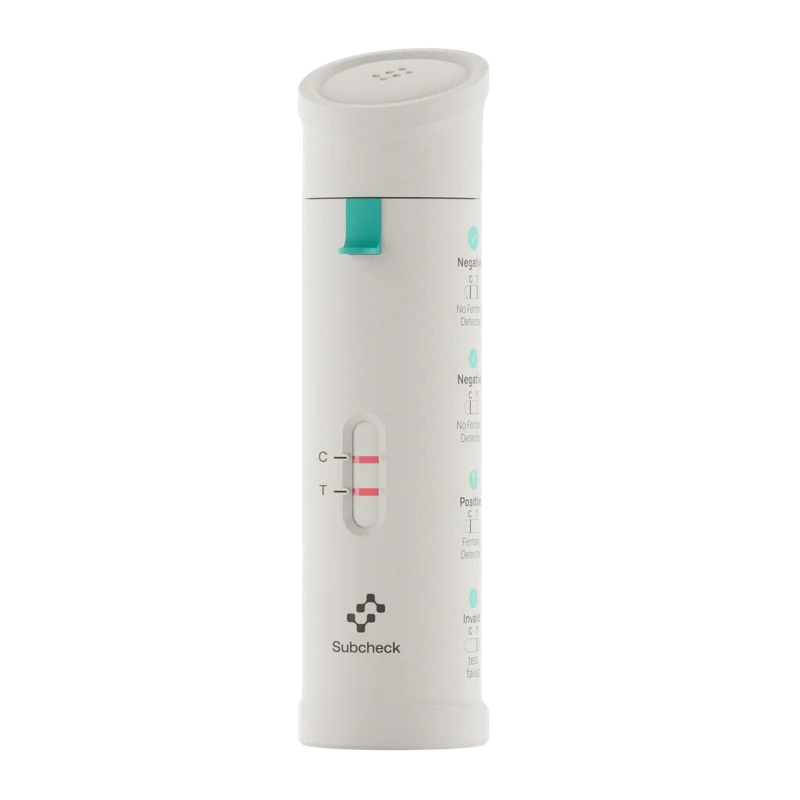
The fewer decisions the user makes, the fewer errors they make. The scoop is pre-measured. The water vessel is pre-filled. SC-X removes all manual steps entirely — insert and press.
Conventional strips ask the user to estimate sample size, find the right amount of water, time the dip themselves, and visually interpret the result under any lighting.
Design for the worst case
Poor lighting. Shaking hands. No training. Language barriers. Visual-first instructions that work without text. High-contrast result lines. Magnification window on SC-X.
Standard test strips include text-heavy instruction inserts in one language and require good lighting and steady hands to read faint lines.
Make the right action the easy action
The scoop is the correct size — you can't over-scoop. The vessel holds the exact volume — you can't over-fill. Correct usage is the path of least resistance.
When the product doesn't constrain the process, correct usage depends entirely on the user's training, attention, and conditions.
Field-proof everything
Room temperature storage. 24-month shelf life. Sealed against moisture. Pocket-sized. No batteries. No calibration. Works in a clinic, a van, a bathroom, or a park.
Some rapid tests require refrigeration, have short shelf lives, or need equipment that limits where they can be deployed.
Proprietary design. Every component — from the micro-scoop geometry to the dissolution mechanism in SC-X — is designed and engineered in-house. These are not off-the-shelf test strips in a pouch.
Under two minutes. Every time.
Same chemistry. You choose the automation.
SC-1 gives the user control and is the lowest cost per test. SC-X removes handling variables mechanically and is more consistent. Both detect 100+ analogs.
High-volume distribution at the lowest cost.
Clinical and supervised settings prioritizing consistency.
What happens inside every Subcheck test
Both products use a competitive binding immunoassay. The strip contains colloidal gold nanoparticles coated with molecules that mimic fentanyl — we call them "fake fentanyl." When real fentanyl is present, it competes with the fake fentanyl for antibody binding sites on the test line.
If real fentanyl wins the competition, no test line forms — one line visible, fentanyl detected. If no real fentanyl is present, the fake fentanyl binds freely — two lines visible, negative result.
The "fake fentanyl" on the colloidal gold flows freely to the test line. Antibodies capture it — a visible line forms. Both test and control lines appear.
Real fentanyl occupies the antibody binding sites first. The colloidal gold passes through uncaptured. No test line forms. Only the control line appears.
Why Subcheck detects what others miss
Conventional strips use one antibody targeting one region of the fentanyl molecule. When that region is modified by illicit chemists, the antibody fails. Subcheck's patented cocktail uses 4+ antibodies targeting different structural regions — so even when one site is modified, others maintain detection.
What to ask any supplier
How many analogs?
Most detect 8–12. The supply has 100+. Ask for published validation data per analog class.
All-in-one or strip only?
If the strip ships alone, you're sourcing water, scoops, and pouches separately — plus paying staff to assemble.
Designed for untrained users?
Visual instructions, pre-measured components, error-resistant design. Ask how the product handles human variability.
Patented chemistry?
Patents indicate real R&D, not relabeled commodity strips. Ask for the number.
Detectable analogs
US 11,874,279
Covers the proprietary antibody cocktail formulation, lateral flow strip architecture, and detection methodology.
Filed: 2021 · Granted: 2024 · Claims: 24
Technical white paper
Full validation data, analog panel results, and peer-reviewed citations.
Request White Paper →